
Every week, Australian businesses face the same crucial question: “I’ve got stock ready in Guangzhou, Shenzhen, or Ningbo, should I book FCL or LCL shipping from China to Australia?”
This single decision affects your cash flow, lead time, and stress levels when delays hit. With Australia importing USD $75.7 billion from China in 2024, getting your FCL vs LCL China to Australia strategy right can save (or cost) thousands per shipment.
What is FCL vs LCL Shipping from China to Australia?
FCL (Full Container Load) – You hire the entire container (20ft or 40ft). It’s loaded at your supplier’s facility, sealed, and stays sealed until it reaches your Australian warehouse or door.
LCL (Less-than Container Load) – You have just a few pallets or cubic metres. Your freight forwarder combines your cargo with others in one container, and you pay only for the space you use.
FCL Shipping China to Australia: When to Choose It
Most Australian importers switch to FCL shipping from China to Australia once they exceed 14-15 cubic metres. Here’s why it makes financial sense at this volume:
Key FCL Advantages
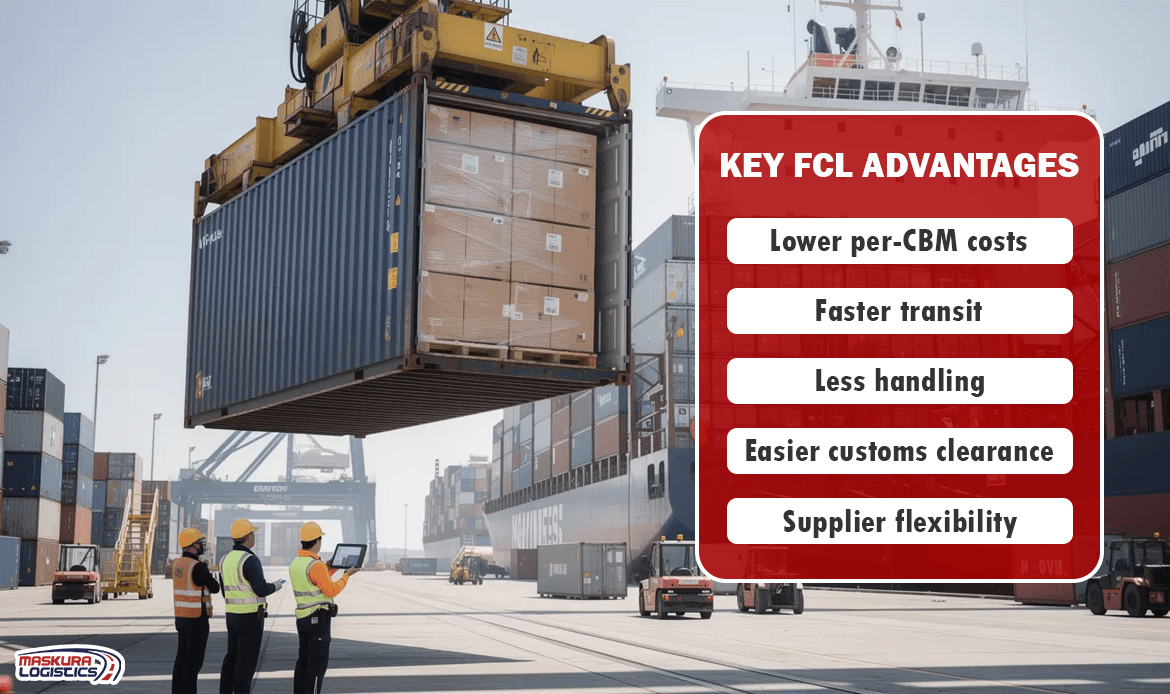
- Lower per-CBM costs – Usually 20-35% cheaper than LCL once you pass the break-even point
- Faster transit – No consolidation delays in China or deconsolidation waits in Australia
- Less handling – Dramatically reduced risk of damage or missing cartons
- Easier customs clearance – Container stays sealed, simplifying biosecurity inspections
- Supplier flexibility – Mix cargo from multiple suppliers into one container
Real-World Example: A Melbourne furniture importer was shipping 12-13 CBM monthly via LCL at $1,200-$1,300 per shipment. After switching to monthly 20ft FCL, their all-in cost dropped to $2,200-$2,400, arrived 10 days faster, and eliminated damage issues entirely.
LCL Shipping China to Australia: Best Use Cases
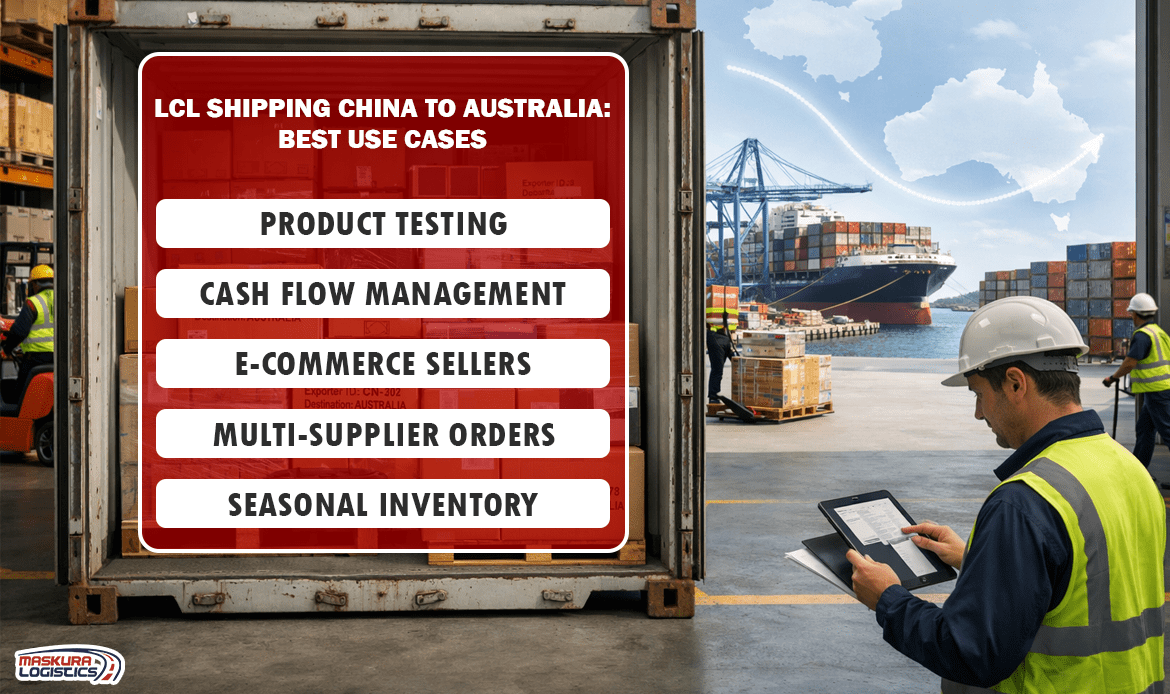
For shipments under 12-13 CBM, LCL shipping from China to Australia almost always wins on price. It’s ideal for:
- Product testing – Sample orders before committing to bulk
- Cash flow management – Avoid tying up capital in large inventory
- E-commerce sellers – Smaller shipments for Amazon FBA or Shopify stores
- Multi-supplier orders – When you can’t fill a full container
- Seasonal inventory – Stock just what you need for peak periods
China to Australia Shipping Costs 2026: Current Pricing
Based on November 2026 market rates, here’s what you can expect for port-to-port shipping:
| Route | 20ft FCL | 40ft HC FCL | LCL per CBM |
| Shanghai → Sydney/Melbourne | $1,350-$2,100 | $2,300-$3,200 | $70-$100 |
| Shenzhen → Brisbane | $1,500-$2,300 | $2,500-$3,500 | $75-$115 |
| Ningbo → Fremantle | $1,400-$2,000 | $2,400-$3,300 | $65-$95 |
Important: Add $450-$750 for Australian destination charges, customs clearance, and delivery for your complete landed cost.
Transit Time Comparison
| Shipping Mode | Port-to-Port | Door-to-Door | Best For |
| FCL | 16-25 days | 20-30 days | High volume, fragile goods |
| LCL | 20-30 days | 25-35 days | Small shipments, testing |
How LCL Consolidation Works
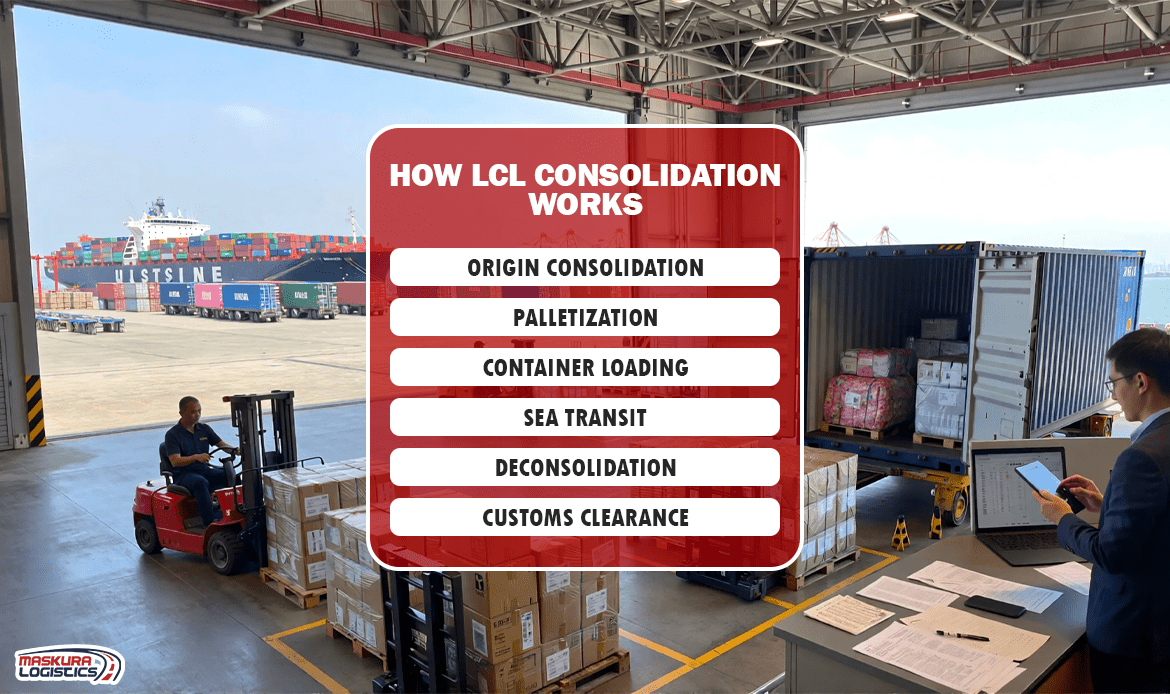
Understanding consolidation helps you plan accurate timelines:
- Origin consolidation – Your cargo goes to a consolidation warehouse in China (Shanghai, Ningbo, or Shenzhen)
- Palletization – Goods are palletized, wrapped, labeled, and combined with other shipments
- Container loading – Mixed cargo sealed in one container heading to the same Australian port
- Sea transit – Standard ocean freight time (20-30 days)
- Deconsolidation – Container unpacked at Australian depot (usually within 5km of the wharf)
- Customs clearance – Your goods separated, cleared individually, and delivered
This process adds 4-10 days compared to FCL, but modern tracking means you always know your shipment’s exact location.
Customs, Duties & GST: What Australian Importers Pay
ChAFTA Benefits
Under the China-Australia Free Trade Agreement (ChAFTA), Australian import tariffs were set at zero on 82% of China’s exports from day one, rising to 100% tariff elimination by January 1, 2019.
Critical requirement: You must obtain a ChAFTA Certificate of Origin to claim duty-free entry. Most goods from China now enter Australia at 0% tariff but proper documentation is essential.
GST Calculation
GST is 10% of the total taxable value, which includes duty, shipping, and insurance. Here’s the formula:
GST = (Customs Value + Duty + Freight + Insurance) × 10%
Example:
- Goods value: AUD $10,000
- Freight & insurance: AUD $2,000
- Duty: $0 (ChAFTA eligible)
- GST base: $12,000
- GST payable: $1,200
Required Import Documentation
| Document | Purpose | Issuer |
| Commercial Invoice | Goods value & description | Supplier |
| Packing List | Cargo details | Supplier |
| Bill of Lading | Proof of shipment | Shipping line |
| Certificate of Origin (ChAFTA) | Duty-free access | Chinese authorities |
| ISPM-15 Certificate | Wood packaging compliance | Treatment facility |
FCL vs LCL Decision Framework: 60-Second Guide
Ask yourself three quick questions:
- Is my shipment more than 15 CBM? → Go FCL
- Do I need it fast, or is it high-value/fragile? → Go FCL
- Am I testing the market or ordering small quantities? → Stay with LCL
If you’re sitting on the 13-16 CBM fence, get quotes for both options. Nine times out of ten, FCL pricing will surprise you on the low side.
2026 Money-Saving Tips for China-Australia Imports
Timing Your Shipments
Peak season sea freight from China to Australia typically runs from September to January, covering Golden Week, pre-Christmas rush, and Chinese New Year lead-up.
Book ahead:
- 3-4 weeks minimum for October-January shipments
- FCL: 3 weeks advance booking
- LCL: 4+ weeks (requires consolidation time)
Container Specifications
20ft Standard Container:
- Internal dimensions: 5.9m (L) × 2.35m (W) × 2.39m (H)
- Volume: 33 CBM
- Max weight: 28,000 kg
40ft High Cube Container:
- Internal dimensions: 12.03m (L) × 2.35m (W) × 2.69m (H)
- Volume: 76 CBM
- Max weight: 26,500 kg
Biosecurity Compliance
- Always use ISPM-15 heat-treated pallets – Non-compliant wood packaging will be rejected
- Declare all wood, seeds, or soil – Biosecurity delays can add weeks
- Check Australian Border Force requirements for your specific product category
Smart Consolidation Strategy
For businesses with 4-5 regular suppliers, consider monthly consolidated FCL. Combine smaller orders from multiple vendors into one container securing FCL pricing and speed while maintaining flexibility.
Major Australian Ports for China Imports
| Port | Location | Best For |
| Port Botany | Sydney, NSW | General cargo, consumer goods |
| Port of Melbourne | Melbourne, VIC | Largest container port, all cargo types |
| Port of Brisbane | Brisbane, QLD | Queensland distribution |
| Fremantle Port | Perth, WA | Western Australia deliveries |
Frequently Asked Questions
How much does it cost to ship a container from China to Australia?
Current rates (November 2025): 20ft FCL costs $1,350-$2,300, while 40ft costs $2,300-$3,500 port-to-port. Add $450-$750 for destination charges and customs clearance.
What is cheaper, FCL or LCL?
FCL is cheaper per cubic metre once you exceed 14-15 CBM. Below 12 CBM, LCL almost always costs less overall.
How long does sea freight take from China to Australia?
FCL typically takes 16-25 days port-to-port, while LCL takes 20-30 days due to consolidation and deconsolidation.
Do I need a customs broker for imports from China?
While not legally required, customs brokers ensure correct HS code classification, ChAFTA compliance, and GST calculation avoiding costly delays and penalties.
What is the minimum volume for FCL shipping?
There’s no minimum, but FCL becomes cost-effective around 14-15 CBM. Below this, you’re paying for empty container space.
How do I calculate CBM for shipping?
CBM (Cubic Metres) = Length (m) × Width (m) × Height (m). For multiple cartons, calculate each box and add totals together.
Insurance & Risk Management
When to Insure
Always insure for:
- High-value cargo ($10,000+)
- Fragile or breakable goods
- Electronics and machinery
- Fashion and branded products
Typical insurance costs: 0.3-0.5% of cargo value
Coverage Differences
- FCL: Lower risk (sealed container, less handling)
- LCL: Higher risk (multiple handling points, consolidation/deconsolidation)
Marine cargo insurance covers loss, damage, and theft during international transit highly recommended for both FCL and LCL shipments.
Final Recommendations
There’s no universal “best” option for FCL vs LCL China to Australia shipping, only what’s optimal for your business right now.
Start with LCL while testing demand and proving your market. Graduate to FCL the moment your volumes consistently hit 14-15+ CBM per shipment. This path has worked for hundreds of Australian importers across various sectors, including furniture, electronics, solar panels, fashion, and machinery.
Current market conditions (November 2025): Rates have stabilized after the volatility of 2021-2023, but the peak season from September to January brings capacity constraints and price increases. Lock in rates 30-90 days ahead. If possible, spot markets can jump 20-30% overnight.
3 replies on “Full Container Load vs Less-Than Container Load for China-Australia Imports: 2026 Complete Guide”
Its like you read my mind! You seem to know a lot about this, like you wrote the
book in it or something. I think that you could do with a few pics to drive the message home a bit,
but instead of that, this is fantastic blog. A great read.
I will certainly be back.
I went over this internet site and I believe you have a lot of superb information, saved to favorites (:.
It is perfect time to make some plans for the future and it is time to be happy. I’ve read this post and if I could I wish to suggest you few interesting things or tips. Maybe you can write next articles referring to this article. I wish to read even more things about it!